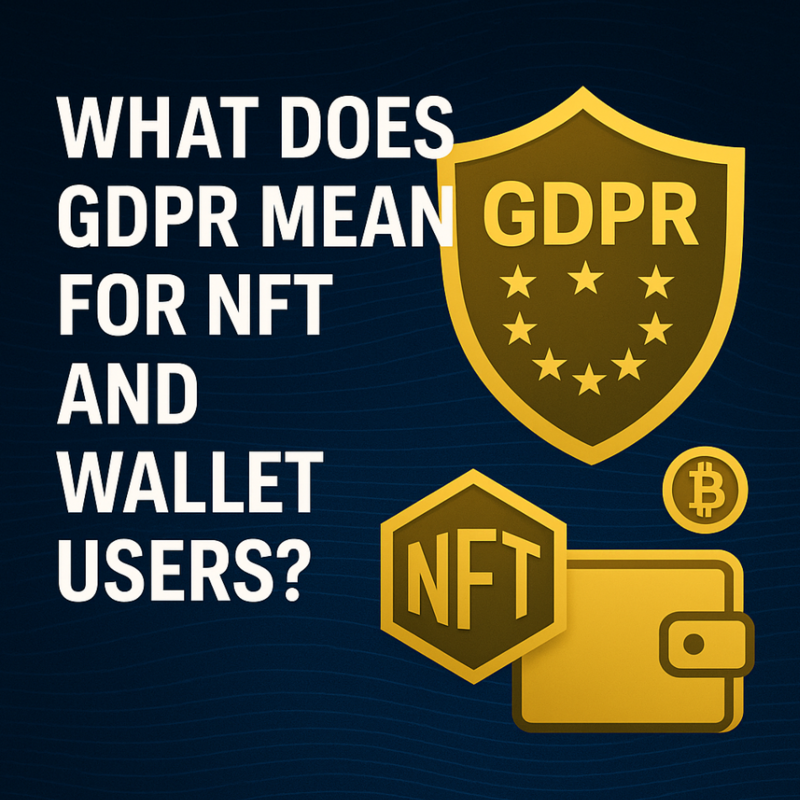
What Does GDPR Mean for NFT and Wallet Users?
The Clash Between Blockchain Decentralization and European Data Protection Law

What Does GDPR Mean for NFT and Wallet Users?The Clash Between Blockchain Decentralization and European Data Protection Law
As of 2025, the widespread adoption of NFTs (non-fungible tokens) and non-custodial crypto wallets has reignited legal concerns about how the European Union’s General Data Protection Regulation (GDPR) applies to blockchain technologies. With NFTs increasingly used for digital identity, memberships, and verifiable credentials, concerns are mounting over whether wallet addresses linked to user behavior constitute personal data under GDPR.
1. What is the GDPR? The GDPR, enacted in May 2018, governs how organizations collect, process, and store the personal data of EU citizens. Its core principles include consent, data minimization, the right to access or erase data, and data portability. Violations may result in fines of up to €20 million or 4% of global annual revenue.
However, GDPR principles are often incompatible with blockchain’s immutability and decentralization, leading to significant friction between regulators and blockchain developers.
2. Are NFTs Considered Personal Data? While NFTs typically consist of public metadata and wallet addresses, they may become personally identifiable when linked to individual identity or user activity—such as attendance at events, reward histories, or digital credentials.
The European Data Protection Board (EDPB) has stated that wallet addresses can constitute personal data if they are uniquely traceable to a user—even pseudonymously. This means that projects issuing NFT-based tickets or loyalty rewards may be subject to GDPR requirements if they can link addresses to real individuals.
3. Do Wallet Users Fall Under GDPR? GDPR applies to data controllers and processors—not individual wallet users. However, DeFi platforms, NFT marketplaces, DAOs, and smart contract developers may fall under GDPR if they collect, process, or analyze data related to wallet activity, especially when tied to IP addresses, social media accounts, or emails.
The growing practice of linking wallet addresses with off-chain identifiers (such as Twitter handles or emails) effectively de-anonymizes wallets, creating direct GDPR compliance obligations.
4. The ‘Right to Be Forgotten’ vs Blockchain Immutability Article 17 of GDPR grants users the right to be forgotten, i.e., to request deletion of their data. This right directly conflicts with blockchain’s core principle of immutability.
To address this, several solutions have emerged:
Off-chain storage of personal data, with only hashed references on-chain
Controllable NFTs (cNFTs) that can be deleted or disabled via smart contract logic
Zero-Knowledge Proofs (zk-proofs) that allow data validation without revealing actual personal data
However, these methods do not fully satisfy GDPR standards yet. Regulators remain cautious, arguing that “technical workarounds” are not a substitute for true compliance.
✅ What Does This Mean for Users? For most NFT or wallet users, GDPR may not apply directly. However, they should avoid linking their wallet addresses with identifiable data across platforms. Participating in reward programs, token-gated communities, or identity NFTs should be done with awareness of how personal metadata might be exposed.
For Web3 developers and platforms operating in or targeting the EU, GDPR compliance measures are essential—from consent collection and data minimization to pseudonymization and opt-out design. The balance between blockchain freedom and data protection regulation is likely to define the future of Web3 adoption in Europe.
<저작권자 ⓒ 코인리더스 무단전재 및 재배포 금지>
|

  많이 본 기사
Insight 많이 본 기사
|